what is a worker cooperative?
There are many types of cooperatives in the United States and across the globe. Many are familiar with consumer cooperatives–common in the food, housing, and utility sectors, and credit unions; and producer cooperatives–common among farmers and artisans. There are also platform, multi-stakeholder, and shared services cooperatives. Each are distinct in their models of ownership and governance.
According to the US Federation of Worker Cooperatives’ Democracy at Work Institute, “worker cooperatives are values-driven businesses that put worker and community benefit at the core of their purpose. In contrast to traditional companies, worker members at worker cooperatives participate in the profits, oversight, and often management of the enterprise using democratic practices. The model has proven to be an effective tool for creating and
maintaining sustainable, dignified jobs; generating wealth; improving the quality of life of workers; and promoting community and local economic development, particularly for people who lack access to business ownership or sustainable work options”.
cepa operates as a Limited Worker Cooperative Association (LWCA), the state of Illinois’ official title for a worker cooperative.
Key elements of cepa planning cooperative:
- Our workers and members own and democratically manage the business. Worker members and community and institutional members guide the decision making and strategic direction of the business, sharing in both the responsibilities and the successes of the cooperative.
- Individuals and organizations from the communities where we work can become members of the cooperative with voting rights and board representation as well as access to training, technical assistance, tools, and continued learning and exchange through our network of diverse communities.
- Unlike a traditional business which prioritizes maximizing profits for shareholders, we share profits among our worker members at an equal rate and distribute them based on the amount of work each person contributes to the cooperative.
- We value all types of knowledge, experience, and skills and create ways for members to invest in the success of the cooperative beyond just monetary contributions.
- We believe that building a strong cooperative economy is the way to a more just, fair, and sustainable world. For this reason, we work to support other cooperatives by patronizing their businesses, seeking out opportunities for peer learning and collaboration, participating in mutual aid, and providing education and assistance for community groups that wish to form their own cooperatives.
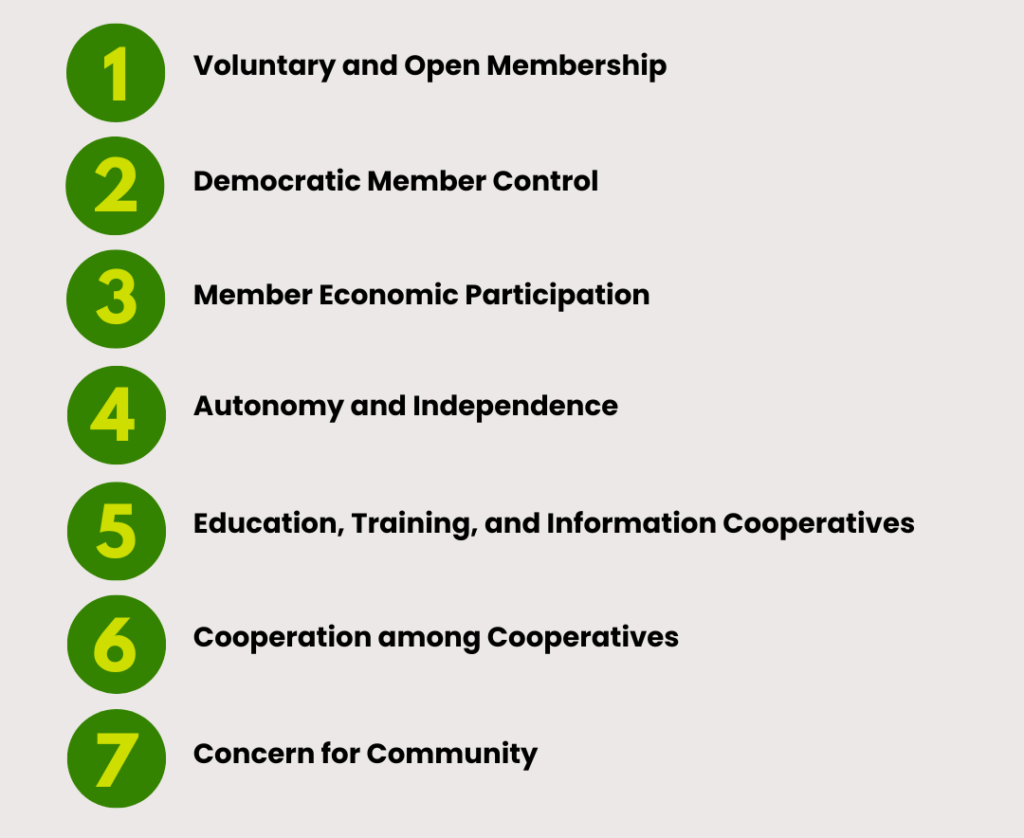
We make business decisions democratically and in accordance with the seven global co-op principles, shared by cooperatives all over the world:
learn more
Note that each state has different laws and regulations related to cooperatives. In addition to those listed below, your state, region, or locality may have additional resources to help you get started.